The Roots of Religion

‘Man is nothing but evolution become conscious of itself’
Julian Huxley - Evolutionary biologist (1887 – 1975)
As self-consciousness gradually evolved among early ape-like humans they would have found themselves in a harsh, uncompromising world – later allegorised in the narratives of various religions, including the Bible’s expulsion from the Garden of Eden. But with humans’ increasing self-awareness came a corresponding decline in the blind animal instinct that had shielded them against the reality of their short, brutish lives.
To survive their relentless dog-eat-dog existence early humans went beyond the basic cooperative behaviour found in other animal species to develop traits that are now considered to be uniquely human, in particular, that of empathy.
THE FIRST GODS
However, while this would have enabled people to live more harmoniously with one another – at least within their own group or tribe – they remained powerless against natural adversities like droughts and famines. In response they began to believe that these were controlled by superhuman forces. These ‘gods’ became personified in rivers, mountains, the sun and the moon.
This may have led to a form of what psychologists now call Stockholm Syndrome, a survival strategy that can occur when hostages develop positive feelings for their all-powerful captors and view any lack of harm as benevolence – possibly an evolutionary stopgap that helped our early ancestors to cope with their hostile existence as they progressed to a better understanding of the world.
But by then the propensity to worship gods seems to have become encoded in our DNA, and viewing the world through a prism of superstition is still today intuitively appealing to the human brain.
RELIGION TAKES SHAPE
This interpretation of naturally occurring events would have gradually developed into localised belief systems and eventually religions and people would have found their rituals and ceremonies a source of comfort and community – similar to those of a Boy Scout group.
Offerings were made – including human sacrifice in some societies and still prevalent in the Americas when the Spanish arrived. Also tribes would have begun to include rules of morality in their beliefs, which in turn reinforced social cohesion and enhanced group survival.
Incorporating supernatural arbitrators in their rewards and punishments was more likely to ensure cooperation and restrain selfishness, not unlike the storylines some children’s stories today. However, children naturally discard belief in Santa Claus and fairies as they mature, whereas prehistoric people were at an earlier stage of cognitive development, so belief in myths would have been lifelong. This system continued for many thousands of years during which time hierarchies of priests became ever more complex and powerful.
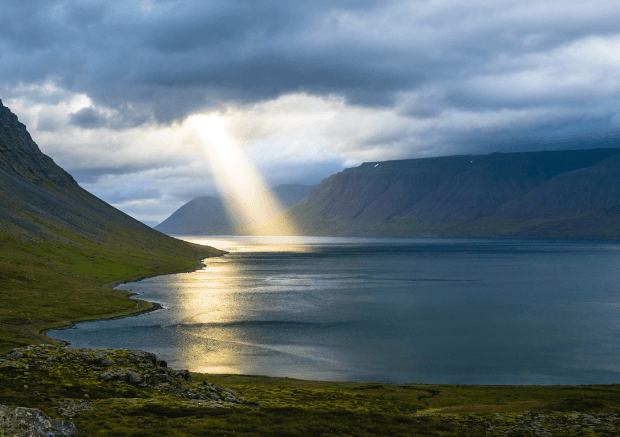
Today, when we look out over the sea or a lake with a full moon shimmering on the water, we marvel at such natural beauty which can move us to poetry, music, art or simply awe. Often, our impulse is to give thanks to a creator who, through his grace, has given us these mesmerising scenes.
CREDIT WHERE DUE
However, we now know through carbon dating and palaeontology that for countless millions of years such scenes have existed with absolutely no one to see and admire them. Then animals began to appear, including dinosaurs, none of which would have been impressed by moonlit nights – apart from them being better for hunting prey.
With the evolution of human species, and eventually Homo Sapiens, came a consciousness that was able to see beauty in such vistas, and indeed it is we who have given such naturally occurring lifeless phenomena meaning and value. Thinking otherwise feeds into the narrative, often promoted by religions, that we are subjects who should be grateful, even humble.
In reality, we are the highest form of life. It is we who have worked ‘miracles’, for example in the field of medicine, saving the lives of millions and alleviating suffering for countless others; and we who made enormous advances in engineering, travel, leisure and even space exploration.
At the same time, we make mistakes. But we can also take steps to rectify them. For example, we are now coming to realise, albeit somewhat belatedly, that we have a responsibility to reverse the enormous damage we have done to the living systems on our planet. And in doing so we secure our own future.
Also, discriminating on the grounds of race, gender and sexual orientation, once acceptable, is no longer tolerated So it seems we are getting there!